How much to charge for mini sessions depends on your market, experience, and what you include — but the short answer is $150 to $350 per session for most photographers in 2026. Beginners in smaller markets start around $150. Established photographers in major cities charge $300 and up. The right price covers every dollar of your expenses, pays you at least $50–75 per hour of actual work (not just the 15 minutes of shooting), and still leaves a profit margin.
The real problem isn't that photographers don't know what others charge — it's that most have no idea what they actually need to charge. They pick a number that feels safe, sell out, and then realize they made less per hour than a teenager working retail once they factor in editing, admin, and taxes. That's the mini session trap: you sell out and still lose money.
So we built a free pricing calculator, wrote out the exact formula, pulled together 2026 market-rate data, and broke down the math on packages, add-ons, seasonal pricing, and the business expenses most photographers forget. Use the calculator below to get your number in about 60 seconds. Then keep reading for the full breakdown.
Mini Session Pricing Calculator
Enter your market, experience, session details, and expenses to get your suggested price range, real hourly rate, and projected revenue per session day.
Mini Session Pricing Calculator
Your Recommended Pricing
Market Position:
How this works: The calculator combines your cost of doing business with market-adjusted hourly rates and factors in the total time per session — not just shooting time. See the full methodology in the References section below.
Put Your Pricing Into Action
MiniShoots handles booking, payments, reminders, waitlists, add-on upsells, and cancellations automatically — so you can focus on shooting, not admin.
Create Your Booking Page Free →What Do Mini Sessions Actually Cost? 2026 Market Rates
Before we get into formulas, here's what photographers are actually charging right now. These ranges are directional estimates based on publicly listed pricing across U.S. portrait photographer websites and booking pages, cross-referenced with industry guidance from the Professional Photographers of America (PPA) and ShootProof. They should be validated against your own costs and local market.
| Market Size | Beginner (0–2 yrs) | Intermediate (2–5 yrs) | Established (5+ yrs) |
|---|---|---|---|
| Small town / rural (under 50K) | $100 – $175 | $150 – $225 | $200 – $300 |
| Mid-size city (50K – 500K) | $150 – $225 | $200 – $300 | $275 – $400 |
| Major metro (500K+) | $175 – $275 | $250 – $375 | $325 – $475+ |
These assume a 15–20 minute session with 5–10 edited digital images. Prices at the higher end typically mean more images, longer sessions, or styled setups. Seasonal sessions — fall, holiday, Valentine's Day — commonly run 15–30% above these base rates based on higher demand and additional setup costs.
The floor is not a recommendation. It's what we're seeing in the market. Photographers charging at the bottom of these ranges are often running the math wrong. The sweet spot for most photographers with a solid portfolio and a year or two of experience lands in the $200–$300 range.
If you're a client reading this to understand what you should expect to pay, these ranges are your guide. Jump to the client section below.
The Mini Session Pricing Formula (Step by Step)
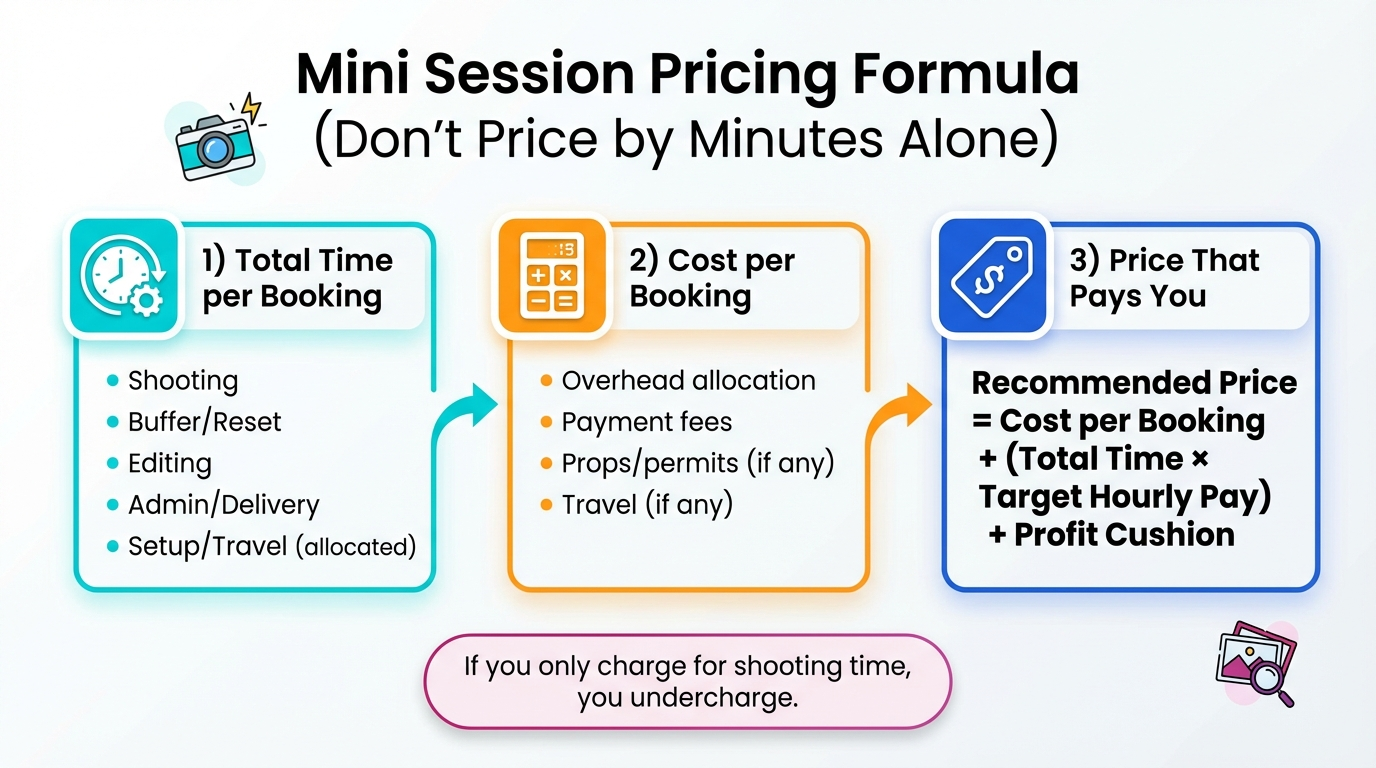
Copying another photographer's price doesn't work because their expenses, market, and hourly target aren't yours. Here's the formula that actually holds up. For a broader look at pricing across all photography types, see our complete photography pricing guide.
Step 1: Add Up Your Monthly Business Expenses
This is your Cost of Doing Business (CODB). It includes everything you spend to operate — not just the obvious stuff. Here's the checklist:
Gear and Equipment
(annual cost ÷ 12): Camera body depreciation, lenses, lighting, memory cards, storage drives, bags, tripods, accessories, gear insurance, repairs.
Software and Subscriptions
Lightroom/Photoshop ($10–22/mo), AI editing tools like Imagen or Aftershoot ($0–40/mo), gallery delivery platform ($0–30/mo), website hosting ($10–30/mo), email marketing ($0–38/mo), accounting software ($0–25/mo), cloud storage ($0–20/mo), contracts/e-signatures ($0–15/mo).
Insurance and Legal
Business liability insurance ($20–50/mo), equipment insurance ($15–30/mo), business license and permits (varies), LLC or entity filing (annual).
Marketing
Website domain ($10–15/yr), social scheduling tools ($0–25/mo), paid ads (varies), print materials, networking events.
Taxes — The Expense Most Photographers Forget
Self-employment tax is 15.3% on your net self-employment earnings (calculated on 92.35% of net profit). Then add federal income tax (10–37% depending on bracket) and state income tax (0% in some states, up to 13.3% in California). The rule of thumb: set aside 25–35% of gross revenue for taxes.
What this typically adds up to:
| Photographer Level | Typical Monthly Expenses |
|---|---|
| Newer, minimal tools | $300 – $600 |
| Mid-level, full software stack | $800 – $1,500 |
| Established, full operation | $1,500 – $3,000+ |
Step 2: Calculate Your Real Time Per Session
This is where most photographers get it wrong. They think a mini session takes 15 minutes. It doesn't. Here's what a single mini session actually costs you in time:
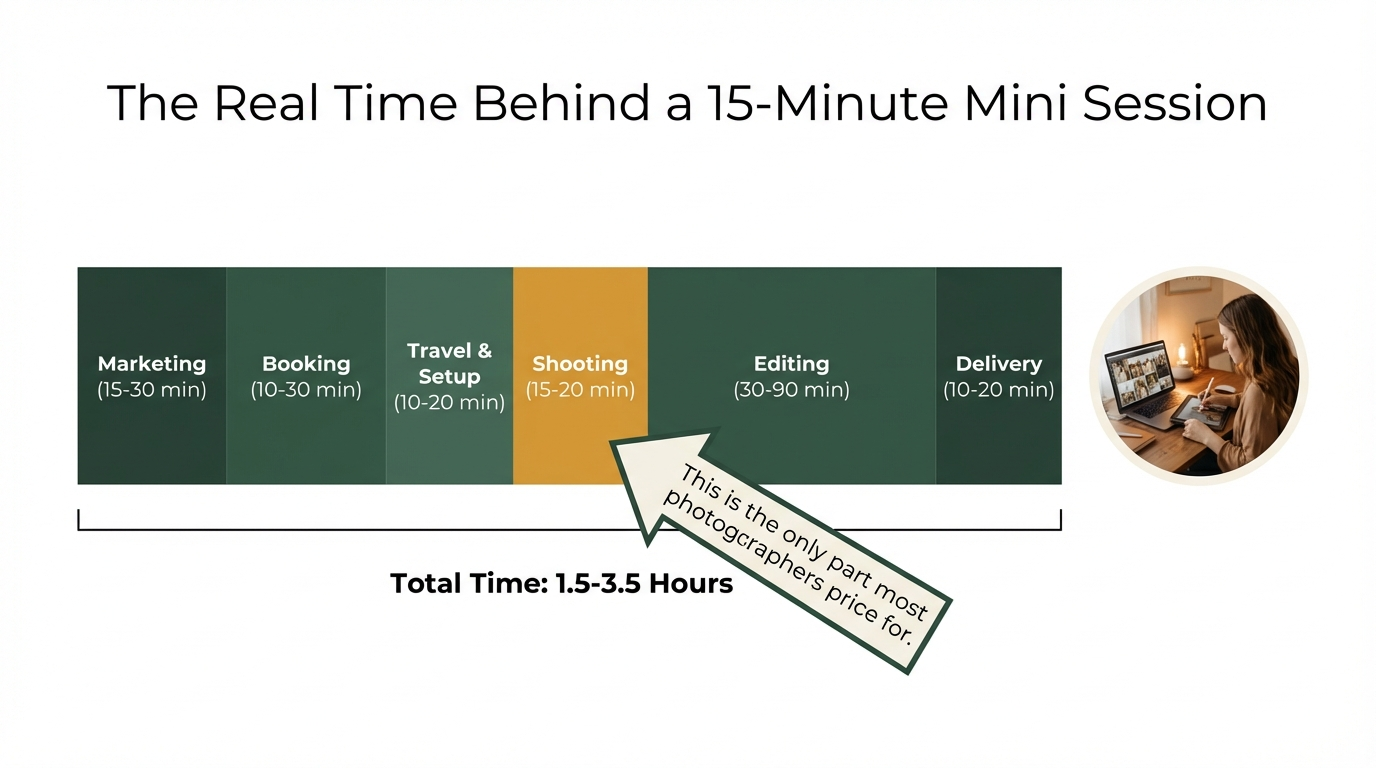
| Task | Time Per Session |
|---|---|
| Marketing and promotion (amortized) | 15–30 min |
| Booking and client communication | 10–30 min |
| Travel and location setup (amortized across day) | 10–20 min |
| Shooting | 15–20 min |
| Culling and editing | 30–90 min |
| Gallery delivery and follow-up | 10–20 min |
| Total | 1.5–3.5 hours |
A "15-minute mini session" is 1.5 to 3.5 hours of real work. If you're pricing based on 15 minutes, you're working for a fraction of what you think you're earning.
The biggest time variable is editing. If you edit heavily (skin retouching, composites, heavy color grading), you're on the high end. If you use a consistent preset with minimal per-image adjustment, you're on the low end.
Automation matters here too. If you're manually handling booking, sending confirmation texts, chasing payments, and managing cancellations, that's 20–30 minutes per client. Booking platforms (including MiniShoots) cut that to near zero.
Step 3: Set Your Hourly Rate
You're running a business. Pay yourself like it.
| Level | Hourly Rate |
|---|---|
| Absolute minimum (breakeven) | $50/hr |
| Comfortable (covers taxes + savings) | $75/hr |
| Profitable (building the business) | $100–125/hr |
For context: a Costco cashier in many states makes $18–22/hour. You're a skilled professional with expensive equipment and years of practice. $50/hour is the floor, not the goal.
Remember to account for self-employment taxes. If you want to take home $50/hour, you need to gross closer to $65–70/hour after SE tax and income tax. Build that buffer into your rate.
Step 4: Run the Formula
Minimum Session Price = (Monthly Expenses ÷ Sessions Per Month) + (Total Hours Per Session × Hourly Rate)
Then add 20–30% for profit margin.
That's the target price. Not a guess. Not a vibe. Math.
Step 5: Validate Against Your Market
Pull up your calculator number and compare it to the market-rate table above. Here's how to interpret the comparison:
- Your number is below the range for your market? You're probably undervaluing yourself. Check your hourly rate — is it above $50?
- Your number is within the range? Good. Price at or slightly above your calculated number.
- Your number is above the range? That's fine if your portfolio, brand, and client experience justify it. Premium pricing works when the experience matches.
- Your number is way above the range? Double-check your expense inputs. If your costs are genuinely that high, you may need to either reduce overhead or accept that mini sessions aren't your most profitable format.
How Session Length and Deliverables Change the Price
The two biggest pricing levers (after market and experience) are how long the session runs and how many edited images you include.
| Session Length | Typical Images | Typical Price Range | Profit Per Hour |
|---|---|---|---|
| 10 minutes | 3–5 | $100 – $200 | Highest |
| 15 minutes | 5–10 | $150 – $300 | High |
| 20 minutes | 8–15 | $175 – $350 | Moderate-High |
| 30 minutes | 10–20 | $225 – $450 | Moderate |
Shorter sessions usually earn more revenue per hour of shooting time — but your true profitability depends on editing and admin time per client. Four 15-minute sessions at $225 each = $900 per hour of shooting. Two 30-minute sessions at $350 each = $700 per hour of shooting.
The 15-minute session with 5–7 included images is the industry sweet spot. It's long enough to deliver real value (families with young kids don't need more than 15 minutes anyway). And the images you shoot but don't include become your most profitable upsell.
How Many Photos Should You Include?
| Model | Images Included | Editing Workload | Upsell Potential | Best For |
|---|---|---|---|---|
| Lean (5–7 images) | Low base | Lowest | Highest | Maximizing add-on revenue |
| Standard (8–12 images) | Medium base | Medium | Medium | Balancing value + profit |
| Full gallery (15–25 images) | High base | Highest | Lowest | Premium/luxury positioning |
Most profitable approach: include 5–7 in the base price, shoot 20–25, and offer the rest as add-ons. Clients get a great selection, and you have a natural upsell built into every booking.
Seasonal Pricing: When to Charge More
Not all mini sessions are created equal. Fall and holiday sessions have the highest demand, justify styled setups, and your clients are working against a deadline (Christmas cards don't wait). Price accordingly. For more on timing and marketing your seasonal events, see our mini session marketing ideas guide.
| Season / Theme | Demand | Premium Over Base Rate | Why |
|---|---|---|---|
| Fall foliage (Sep–Nov) | Highest | +20–30% | Peak family photo season. Annual photos + holiday card images. |
| Holiday / Christmas (Nov–Dec) | Highest | +20–30% | Styled sets, props, Santa themes. Higher setup costs justify higher price. |
| Valentine's Day (Feb) | Medium-High | +10–20% | Couples and kids. Smaller audience, dedicated buyers. |
| Spring / Easter (Mar–Apr) | Medium-High | +10–20% | Blooming backgrounds. Second-biggest season in most markets. |
| Back-to-School (Aug–Sep) | Medium | +5–15% | Growing segment, especially milestone sessions. |
| Summer (Jun–Aug) | Moderate | Base rate | Lower demand. Beach and waterfront themes work well. |
💡 Holiday Mini Sessions
Christmas and holiday sessions are the single biggest revenue opportunity for mini session photographers. Families are motivated by a hard deadline, they're already in spending mode, and they want professional photos they can share. This is the one season where you should absolutely invest in a styled set, charge 20–30% above your base rate, and not feel a shred of guilt about it.
Cancellation, No-Show, Reschedule, and Weather Policies
Having clear policies before you start booking will save you from painful conversations, lost revenue, and one-star reviews. For an in-depth look at preventing no-shows, see our complete no-show prevention guide. For contract specifics, check our mini session contract template.
What Your Policies Should Cover
Cancellation policy: Most photographers offer a full refund (or credit toward a future session) if the client cancels 48–72+ hours before the session. Cancellations within 48 hours forfeit the deposit or session fee. This is standard and fair.
Reschedule policy: Allow one free reschedule if done 48+ hours in advance. After that, a $25–50 reschedule fee is reasonable. This prevents serial reschedulers from tying up your calendar.
No-show policy: If a client doesn't show up and didn't cancel, you keep the session fee. Period. This is why requiring payment at booking matters.
Weather / rain plan: This is non-negotiable for outdoor sessions. Your options:
- Automatic reschedule to a designated backup date
- Move to a covered or indoor location
- Full refund if neither option works
Sample Policy Language
Cancellation: Full refund if canceled 72+ hours before session. Cancellations within 72 hours forfeit the session fee. No-shows forfeit the session fee.
Reschedule: One free reschedule allowed 48+ hours before session, subject to availability. Additional reschedules: $35 fee.
Weather: If weather forces cancellation, you may reschedule to [backup date] or receive a full refund. Photographer will notify clients by [time] on the day of the session.
Turnaround: Edited images delivered within 14 business days via online gallery.
Automate Your Policies and Payments
MiniShoots collects full payment at booking, enforces cancellation policies automatically, and manages waitlists so cancelled slots get filled instantly.
Try MiniShoots Free →Add-On Upsells: How to Increase Your Revenue Per Session
Your session fee is the floor. Add-ons are where your real revenue lives. Add-ons offered during the booking checkout — when the client is already committed and in buying mode — convert significantly better than post-session upsell emails.
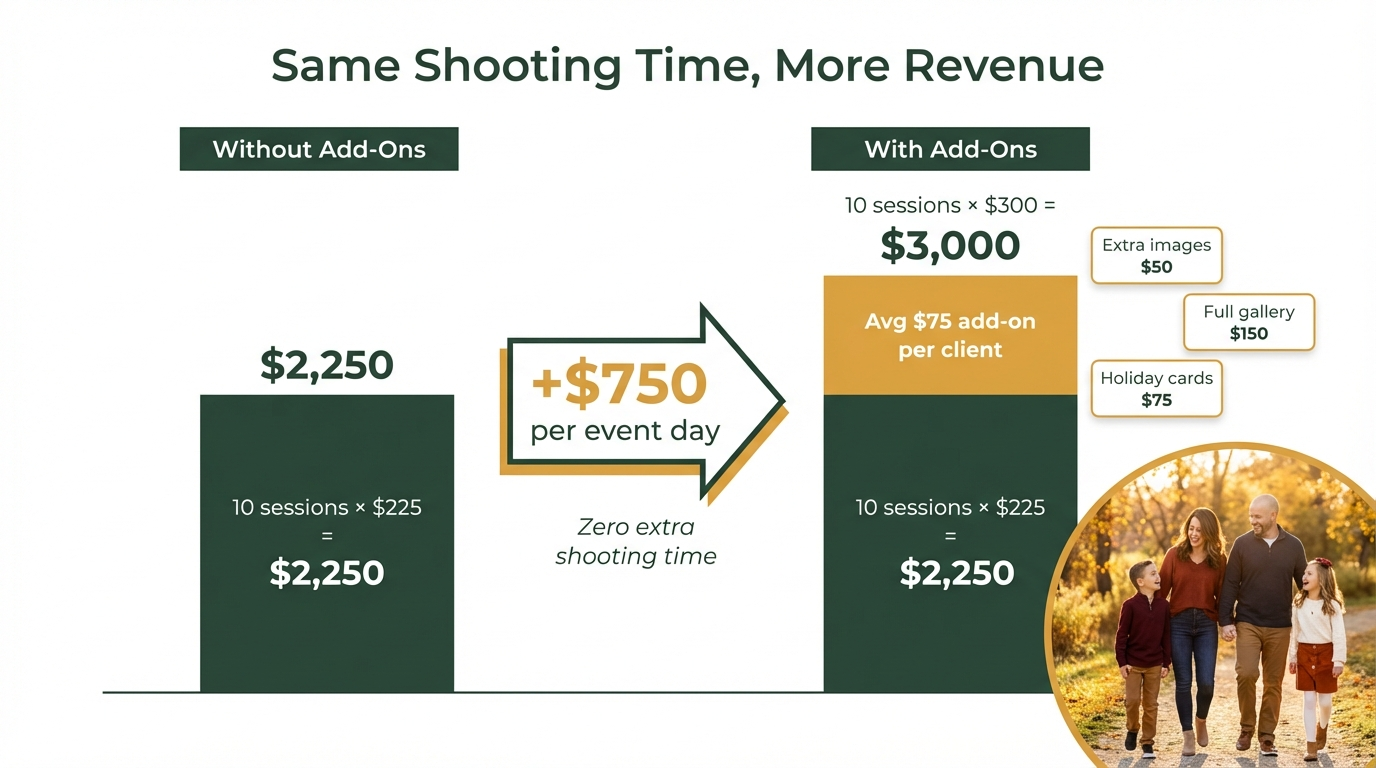
| Add-On | Typical Price | Est. Take Rate | Revenue Impact |
|---|---|---|---|
| Extra edited images (3–5 more) | $25 – $75 | ~40–60% | High |
| Full gallery upgrade (all images) | $100 – $250 | ~15–25% | Very High |
| Outfit change (+5–10 min) | $25 – $50 | ~20–35% | Medium |
| Extended time (+10–15 min) | $50 – $100 | ~10–20% | Medium |
| Holiday cards (pack of 25) | $50 – $100 | ~25–40% | Seasonal |
| Same-day sneak peek (1–2 images) | $15 – $35 | ~30–50% | Low-Medium |
| Print credit / package | $50 – $150 | ~15–30% | High |
| Digital download package | $75 – $200 | ~20–40% | High |
Take rates are estimated ranges based on common photographer reports. Your actual rates will vary by market, client base, and how/when you present the offer.
Package Tiers: Should You Offer Good / Better / Best?
Offering 2–3 pricing tiers tends to increase your average booking value because of a well-documented psychological effect: most people pick the middle option. (This is called the "center-stage effect" or "compromise effect" in pricing psychology.) But don't overcomplicate it — more than three tiers creates decision paralysis, and decision paralysis kills bookings.
| Starter | Standard | Premium | |
|---|---|---|---|
| Session length | 15 min | 20 min | 25–30 min |
| Edited images | 5 | 10 | 20 |
| Outfit change | No | No | Yes |
| Print credit | — | — | $50 included |
| Example price (mid-market) | $175 | $275 | $400 |
The "Starter" tier makes "Standard" look like great value. "Premium" makes "Standard" feel affordable. You want 50–60% of clients choosing Standard, 20–30% choosing Premium, and only 10–20% choosing Starter.
You can also skip tiers entirely and offer a single package with à la carte add-ons. Single package + add-ons at checkout is actually what we see working best for photographers who run high-volume mini session days.
Deposits vs. Full Payment: Which to Require
This decision directly affects your no-show rate and your cash flow. For a deep dive on deposit strategy, see our photography deposits guide.
| Factor | Full Payment Upfront | Deposit + Balance |
|---|---|---|
| Booking conversion | Slightly lower | Slightly higher (lower sticker shock) |
| No-show rate | Very low (payment is committed) | Higher (varies by deposit amount) |
| Cash flow | Immediate | Split |
| Admin work | Minimal | More (balance collection) |
| Best for | Sessions under $300, high demand | Sessions $300+, premium positioning |
Our recommendation for most photographers: require full payment at booking for sessions under $300. It's simpler, eliminates no-shows, and clients expect it.
For higher-priced sessions ($300+), a 50% non-refundable deposit at booking with the balance due 48–72 hours before the session works well. The key word is non-refundable.
Don't forget payment processing fees. For online card payments, Square charges around 2.9%–3.3% + 30¢ depending on your plan. You can either absorb fees (build them into your session price) or pass them to clients as a line item. Either approach is fine — just be transparent about it.
Mini Sessions vs. Full Sessions: Pricing Both Without Cannibalizing
If you offer both mini and full sessions, your pricing needs a clear gap between them. Otherwise, no one books the full session — they'll just keep booking minis.
| Mini Session | Full Session | |
|---|---|---|
| Length | 10–20 min | 45–90 min |
| Location | 1 (photographer's choice) | 1–3 (client's choice) |
| Images | 5–15 edited | 25–75+ edited |
| Outfit changes | 0–1 | 2–4 |
| Typical price | $150 – $350 | $400 – $1,000+ |
| Per-hour revenue | Higher | Lower |
| Best for | Quick annual photos, seasonal themes, new client acquisition | Milestones, branding, multi-location, clients who want the full experience |
🎯 The Gateway Strategy
Full sessions should cost at least 2x your mini session price. If your mini is $250, your full session should be $500 minimum. Think of minis as the gateway. A family books a $225 fall mini, loves the experience, and comes back six months later for an $800 family session. The mini was the introduction, not the destination. Learn more about how to run profitable mini sessions that convert to full session clients.
The 10-Minute "Near Me" Benchmark Method
You've got your calculated price. Now you want to know how it stacks up locally. Here's how to benchmark your area without spending half a day researching.
- Search "[your city] mini sessions" and "[your city] mini session photographer" on Google and Instagram
- Check 8–10 photographer websites or booking pages — look for their mini session pricing
- Record the session length, number of images, and price for each
- Note which photographers are booked out (check their social media for "SOLD OUT" posts) — those prices are validated by demand
- Ignore anyone running a promo or loss-leader price — that's not sustainable and you shouldn't match it
What to Track
| Photographer | Minutes | Images Included | Price | Add-Ons? | Deposit Policy | Sold Out? |
|---|---|---|---|---|---|---|
| Example A | 15 | 10 | $225 | Yes | Full upfront | Yes |
| Example B | 20 | 5 | $175 | No | $50 deposit | No |
| Your research... | ... | ... | ... | ... | ... | ... |
The photographers who are sold out at $250+ are your real benchmark. The ones charging $75 and struggling to fill slots are cautionary tales, not competition.
One important note from the PPA: don't base your price solely on what others charge. Your costs, your time, and your goals are different. Use the benchmark to validate your calculated price, not to replace it.
7 Pricing Mistakes That Cost Photographers Thousands
These are the errors we see constantly. Most of them are easy to fix once you see them.
- Pricing based on what other photographers charge instead of your own costs. Their expenses, their market, and their goals aren't yours. Copy their price and you're running someone else's business model — one that might not even be profitable for them.
- Forgetting taxes exist. Self-employment tax alone is 15.3% on your net self-employment earnings. Add federal and state income tax and you're looking at 25–35% of gross revenue going to taxes. A $200 session may net you $130–150 after taxes. Price accordingly.
- Counting shooting time as your total time. A 15-minute mini session is 1.5–3.5 hours of real work. If you price for 15 minutes, you're making $10–20/hour after expenses.
- Including too many images in the base package. If you deliver 20 edited images for $175, you've eliminated your best upsell opportunity and given yourself hours of extra editing. Include 5–7 and make the rest available as add-ons.
- Not requiring payment at booking. Unpaid bookings have dramatically higher no-show rates. Full payment or a non-refundable deposit at booking. No exceptions. Learn more about preventing no-shows.
- Charging the same price year-round. Fall and holiday sessions are peak demand. If you don't adjust for seasonality, you're leaving real money on the table.
- Racing to the bottom on price. Clients who choose solely on price are statistically your most difficult clients — more cancellations, more complaints, less likely to buy add-ons or return. Compete on the experience, your editing style, and convenience. Not price.
Stress-Test Your Price Before You Publish It
Most guides stop at "here's your price." But what happens if only 60% of your slots book? What if you have a rainout? Here's how to make sure your price holds up in the real world.
Break-Even Sessions Per Month
How many sessions do you need to book each month just to cover your overhead?
Formula: Monthly Fixed Expenses ÷ (Session Price − Variable Costs Per Session) = Break-Even Sessions Per Month
Effective Hourly Earnings (The Truth Metric)
This is the number that actually matters. Not revenue per day. Not session price. Your effective hourly earnings before taxes.
Formula: (Session Price − Expense Per Session) ÷ Total Hours Per Session = Effective Hourly Earnings
Sensitivity Check
| Scenario | Fill Rate | Revenue (10-slot day) | Est. Earnings After Overhead |
|---|---|---|---|
| Great day | 100% | $2,750 | ~$2,000 |
| Good day | 80% | $2,200 | ~$1,550 |
| Okay day | 60% | $1,650 | ~$1,100 |
| Bad day | 40% | $1,100 | ~$650 |
Assumes $275/session, ~$75 in overhead and variable costs per session. Earnings shown are before taxes.
Even at 60% fill rate in this example, you're still in the green. That's a resilient price.
Pricing Examples: Real Scenarios You Can Copy
Theory is great. But most photographers learn best by seeing how the math works in specific situations. Here are six scenarios across different markets, experience levels, and session types. Run your own numbers through the calculator above, then compare.
Ready to Put Your Pricing Into Action?
Set your price, share your booking link, and let clients book and pay in one step. No chasing DMs. No spreadsheets.
Create Your Booking Page Free →How to Present Your Price (So People Actually Book)
Having the right price means nothing if you communicate it poorly. Here's what works.
Anchor With Your Full Session Price
Show your full session price alongside your mini session price. A $750 full session makes a $250 mini feel like a deal. This isn't manipulation — it's context. Clients should understand they're getting a streamlined version of a premium service.
Use Real Scarcity (Not Fake Scarcity)
Mini sessions have built-in scarcity: limited time slots. Use it honestly. "8 slots available" or "5 spots left" is factual if it's true. Don't use countdown timers that reset or claim "last chance" every week.
Be Clear About What's Included
Your booking page or announcement should spell out:
- Session length
- Number of edited images
- Turnaround time
- What's NOT included (and available as add-ons)
- Cancellation/reschedule policy
- Rain plan
Vagueness kills bookings. Clients who don't understand what they're getting don't book — they just move on to the next photographer who made it clear.
Social Media Announcement Template
Keep it factual. No "DM for pricing." No "starting at..." without specifics. People want to know exactly what they're getting and what it costs before they click.
Launch Timeline That Fills Slots
- 2 weeks out: Tease the dates and theme on social media. Drop behind-the-scenes of your setup or last year's session photos. Open VIP/email list early access.
- 10 days out: Open booking to your email list and past clients. This is your warmest audience and they should get first pick. If you sell out here, your pricing is validated — and probably too low.
- 7 days out: Open booking publicly on social media. Post your announcement with the link.
- Day 1–3: Share a "slots filling up" update if it's true. Do NOT fake urgency.
- After sellout: Activate your waitlist. When cancellations happen (they will), the next person on the list gets an automatic offer.
The early-access window creates real urgency and rewards your community. It's also your best price-testing mechanism — if VIPs sell you out in 24 hours, raise your price $25–50 next time. For more strategies, check out our mini session marketing ideas guide.
What Clients Should Expect to Pay for Mini Sessions
If you're a parent or a client researching mini session costs, this section is for you.
In 2026, expect to pay $100–$400 for a mini session depending on where you live, the photographer's experience, and what's included. The national average is around $200–$250 for a 15–20 minute session with 5–10 edited digital photos.
What's Typically Included
- 10–20 minutes of shooting time at a location the photographer selects
- 5–10 professionally edited digital images
- An online gallery for downloading your photos
- Print release (permission to print the photos yourself)
- Delivery within 1–3 weeks
What Usually Costs Extra
- Additional edited images beyond the included number
- Outfit changes
- Extended session time
- Print products (canvas, albums, cards)
- Rush delivery
How to Evaluate if a Price Is Fair
| Price Range | What to Expect |
|---|---|
| Under $100 | Likely a beginner building their portfolio. Quality may be inconsistent. |
| $100–$200 | Entry-level to intermediate. Solid value in most markets. |
| $200–$350 | Experienced photographer with a strong portfolio. The sweet spot. |
| $350–$500 | Premium or established photographer. Exceptional quality. |
| $500+ | Luxury or high cost-of-living areas. |
What to Ask Before Booking
- How many edited images are included?
- Are digital downloads part of the session fee?
- What's the cancellation and reschedule policy?
- Is there a rain plan?
- When will I get my photos back?
- Can I book back-to-back with a friend?
Red Flags to Watch For
- No visible portfolio or recent work (you can't evaluate quality)
- No clear pricing — "DM for details" usually means they're making it up as they go
- No contract or terms of service
- No rain plan for outdoor sessions
- Prices that seem too good to be true (under $75 in most markets means corners are being cut)
On the other end, a photographer charging $400+ should be able to show you a strong, consistent portfolio, clear terms, a professional booking experience, and a specific timeline for delivery. Premium pricing should come with a premium experience from the moment you click "book."
Setting Up Your Booking and Payment System
You've got your price, your packages, and your launch plan. Now you need a way to actually collect bookings and payments without drowning in DMs, Venmo requests, and Google Sheets. For a detailed comparison, see our mini session booking software comparison.
What Your Booking System Needs to Handle
- Real-time slot availability (no double-booking)
- Payment at time of booking (deposit or full)
- Automated confirmation emails and text reminders
- Cancellation and reschedule handling
- Waitlist management when you sell out
- Add-on upsells during checkout
Booking Tool Comparison
| Tool | Starting Price | Built for Mini Sessions? | Payments | Add-On Upsells | Automated Reminders |
|---|---|---|---|---|---|
| MiniShoots | Free (3.9% commission) or $399/yr (0%) | Yes | Square | Yes | Email + SMS |
| HoneyBook | From $29/mo (annual) | No (general CRM) | Stripe/Square | Manual setup | |
| Dubsado | From $35/mo or $335/yr | No (general CRM) | Stripe/Square | Manual setup | |
| Acuity Scheduling | From $20/mo | No (general scheduling) | Stripe/Square/PayPal | Limited | |
| Square Appointments | Free (with Square fees) | No (general scheduling) | Square | No | Email + SMS |
Pricing as of February 2026 (US). Verify current pricing on each vendor's website before purchasing.
The difference between a general booking tool and one built specifically for mini sessions comes down to the details: slot management, deposit-then-balance flows, add-on upsells at the moment of checkout, buddy booking, automated waitlist offers, and self-service rescheduling. General CRMs can be configured to do some of this, but you'll spend hours building workflows that purpose-built tools handle out of the box.
MiniShoots was built for exactly this use case. You create your event, set your price, share your booking link, and everything else — confirmations, reminders, payments, waitlist, cancellations, add-ons — happens automatically. The Starter plan is free with a 3.9% commission per booking. The Pro plan is $399/year with 0% commission.
Frequently Asked Questions
$150 minimum, even if you're brand new. At $150 for a 15-minute session, you're at the low end of the market while still covering basic costs and paying yourself something reasonable. If your CODB calculation shows you need more, charge more. Don't go below $150 or you're almost certainly losing money after taxes and editing time.
5–10 edited images is the standard. The most profitable approach: include 5–7, shoot 20+, and offer the extras as add-ons. Clients get a solid selection, and you keep your best upsell lever.
Yes. Fall and holiday sessions are peak demand. Most photographers charge 15–30% more because demand is highest, clients are motivated by deadlines, and styled sets require additional investment. A $250 base session becomes a $300–325 holiday session.
$200–$450 depending on market and experience. At 30 minutes, you're on the longer end for a mini — most run 15–20 minutes. If you're offering 30-minute sessions, price them as "midi sessions" and include more deliverables.
For sessions under $300, require full payment at booking. It's simpler and eliminates no-shows. For sessions $300+, a 50% non-refundable deposit with the balance auto-charged 48–72 hours before the session works well. See our deposits guide for more details.
Don't match them. $50–$75 mini sessions are unsustainable — those photographers haven't calculated their real costs (or they're deliberately taking a loss to build a portfolio). You aren't competing with them. You're competing for the clients who value quality and will pay $150–$300+ for professional results.
If you sell out within 24–48 hours every time, you're probably underpriced. If you're booking 70–90% of slots within 1–2 weeks, you're in the sweet spot. If you're getting zero bookings, check your marketing before lowering your price — pricing is rarely the real problem when clients aren't finding you.
At least once a year. Raise 10–20% when: you're consistently selling out, your waitlist is growing, you've upgraded your gear or skills, or your costs have gone up. Never lower prices to fill slots — invest in better marketing instead.
For most portrait and family photographers, absolutely — if you price them right. The photographers who burn out on minis are the ones charging $75 and editing 25 images per client. At $250+ with 5–7 images and add-ons, mini sessions are one of the most time-efficient revenue streams in portrait photography. Learn how to run mini sessions profitably.
Have a rain plan. Communicate it in your booking terms before clients pay. Options include: automatic reschedule to a backup date, move to an indoor/covered location, or full refund. Whatever your policy is, make it clear at booking so there are no surprises.
It's reasonable to add $25–50 for groups of 6 or more, or $10–15 per additional person beyond 5. Larger groups take more time to pose, more frames to get everyone looking good, and more editing time. If you don't charge extra, at least note in your terms that sessions are designed for families of up to 5.
Keep a clear gap. Your full session should cost at least 2x your mini session. Position minis as a streamlined, seasonal option — not a discount version of your regular work. Clients who want the full experience (multiple locations, outfit changes, more time) should see clear value in upgrading.
Both work, but they require different positioning. Seasonal minis benefit from built-in demand and natural scarcity. Year-round minis work if you brand them around specific themes or life events (milestones, "just because" family updates). The key is that each event feels intentional and limited — not like a perpetual discount.
References and Methodology
How the calculator works: The pricing calculator combines your Cost of Doing Business (CODB) with market-adjusted hourly rates and accounts for total time per session — including editing, admin, and setup — not just shooting time. Market and experience multipliers are derived from publicly listed pricing across U.S. portrait photographer websites and industry reports. The calculator's purpose is directional guidance, not financial advice.
Sources Cited
- Professional Photographers of America (PPA) — Photography pricing guidance and mini session best practices (ppa.com)
- IRS — Self-employment tax rates and small business tax obligations (irs.gov)
- Square — Payment processing fee schedule (squareup.com)
- HoneyBook — Pricing plans (honeybook.com/pricing)
- Dubsado — Pricing plans (dubsado.com/pricing)
- Acuity Scheduling — Pricing plans (acuityscheduling.com)
- Square Appointments — Pricing plans (squareup.com)
- ShootProof — Mini session pricing data and CODB methodology (shootproof.com)
Data methodology: Market-rate ranges are directional estimates based on a survey of publicly listed pricing from U.S. portrait photographers across small, mid-size, and major metro markets, conducted in early 2026. Pricing was collected from photographer websites, booking pages, and public social media announcements, then cross-referenced with published industry guidance from PPA and ShootProof.
Disclaimer: This guide provides general business pricing guidance for educational purposes. It is not financial, tax, or legal advice. Consult a qualified accountant or tax professional for advice specific to your situation.
Ready to Put Your Pricing Into Action?
MiniShoots handles booking, payments, reminders, waitlists, add-on upsells, and cancellations automatically — so you can focus on shooting, not admin. Create your first booking page free.
Get Started Free - No Credit Card Required →